Coquitlam to YVR by Limo: Timing, Pickup Locations and Luggage Planning
October 18, 2026
Downtown Vancouver to YVR by limo works best when the pickup is planned backward from your flight rather than attached to a fixed travel-time promise. Your schedule needs to allow for hotel loading, elevator delays, traffic on the route to Richmond, airport curb procedures and the time required inside the terminal.
Start with your required airport arrival time
YVR advises passengers to arrive at least two hours before a domestic departure and at least three hours before a U.S. or international departure. Those are airport-planning benchmarks, not the time your limo should reach the hotel.
| Flight type | Target arrival at YVR | Planning consideration |
|---|---|---|
| Domestic | At least 2 hours before departure | Allow time for hotel loading, the drive and airport check-in. |
| U.S. or international | At least 3 hours before departure | Build in additional time for check-in, security and border-related processing. |
A useful calculation is:
Hotel pickup time = target airport arrival time − loading time − estimated drive time − traffic and weather buffer.
The drive from Downtown Vancouver is not a guaranteed number of minutes. The hotel entrance, time of day, road construction, rain, bridge conditions and major events can all change the journey. A chauffeur or dispatcher should reassess the route on the day of travel instead of relying only on a historical average.
How much traffic buffer should you add?
For a routine transfer outside the busiest periods, adding approximately 15 to 20 minutes beyond the normal route estimate is a sensible conservative starting point. During weekday morning or afternoon peaks, heavy rain or periods of unusually busy traffic, a 30- to 45-minute buffer may be more appropriate. Major events, collisions, winter conditions or congestion around the Oak Street Bridge may require still more time.
The route commonly uses Vancouver’s downtown street network, Arthur Laing Bridge and Highway 99 toward the airport. Before leaving, the travel team can review DriveBC’s Highway 99 camera near Shell Road and other current traffic information. The Oak Street Bridge is also a monitored Highway 99 location, but live conditions matter more than a typical off-peak estimate.
- Weekday morning flight: Plan conservatively because downtown traffic and bridge demand can build at the same time.
- Weekday afternoon or evening flight: Leave room for the afternoon peak, sporting events, concerts and road incidents.
- Weekend flight: Traffic may be lighter, but airport demand, construction and special events can still affect the route.
- Heavy rain or winter weather: Increase the buffer and expect slower loading and driving conditions.
- Large group or many bags: Add time at the hotel, particularly if the vehicle must wait for several passengers to reach the entrance.
Hotel pickup details that affect the schedule
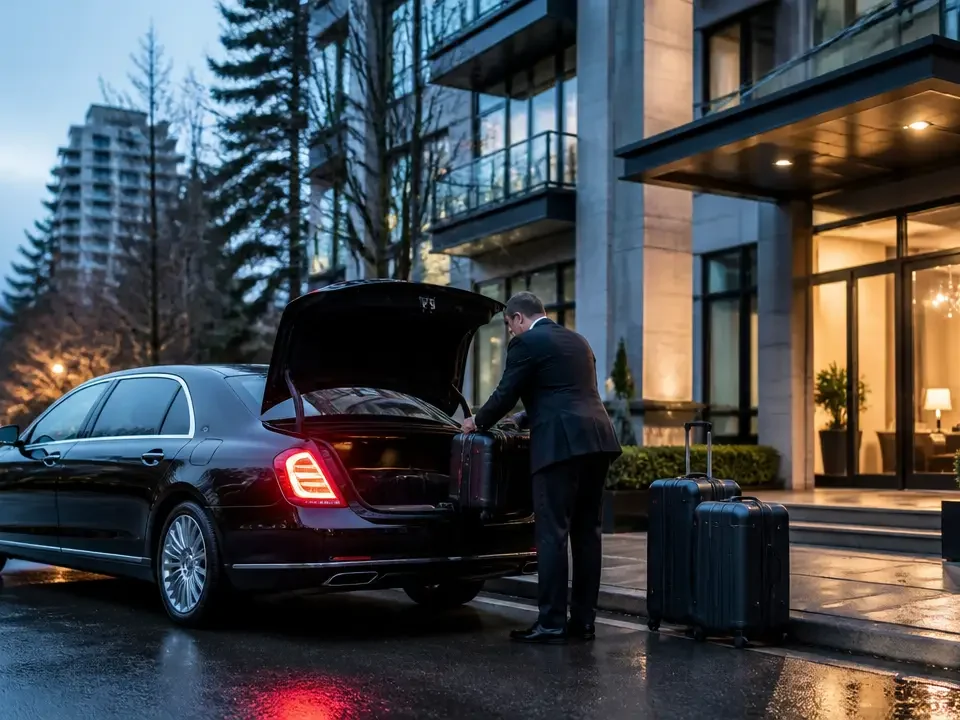
A hotel pickup is more than a vehicle arrival time. Tell the limo company the hotel name, the preferred entrance, your flight number, the number of passengers and the approximate amount of luggage. A downtown hotel may have a busy curb, a loading restriction or a separate porte-cochère. Confirming the exact entrance avoids a driver waiting at the wrong side of the building.
Have bags ready before the chauffeur arrives. Elevators, valet requests, a delayed member of the group or a last-minute checkout issue can use up the buffer that was intended for the highway. Families should also mention child-seat needs, while passengers with accessibility requirements should discuss them at booking rather than at the curb.
Where your limo goes at YVR
For departures, YVR directs vehicles to the Departures Level 3. The curb is for immediate unloading, so luggage should be organized before the vehicle reaches the terminal. Vehicles cannot be left unattended, and passengers should confirm their airline and check-in area in advance.
The main terminal’s levels can be confusing when a traveler is working from an old itinerary or a text message. Departures and check-in are on Level 3. Domestic and international arrivals are on Level 2, while the Airport Services Plaza is on Level 1. The Canada Line station is on Level 4. YVR’s official terminal maps are worth checking before the trip, especially for passengers meeting a chauffeur after landing.
Arrivals: flight monitoring and curbside meeting points
For an airport pickup, provide the flight number when booking. The YVR arriving-flights page shows scheduled and estimated times, flight status, terminal information and baggage-carousel details. Monitoring the flight allows dispatch to respond to a delay or an early arrival instead of sending the vehicle to the curb too soon.
U.S. and international passengers should exit through International Arrivals and proceed toward the public passenger pickup area after Door 17. Domestic passengers use Door 24 on Level 1 Airport Services Plaza. These areas are intended for immediate loading. A chauffeur should not remain at the terminal curb while a passenger is still clearing customs or waiting for checked bags.
YVR provides a free cellphone waiting area on Aviation Avenue. The practical arrangement is for the chauffeur to wait there, monitor the flight, and move to the agreed pickup point when the passenger confirms that they are outside with luggage. This is more reliable than asking the passenger to search for a vehicle while still inside the terminal.
Why a limo can be useful compared with the Canada Line
The Canada Line connects YVR with Waterfront Station in approximately 25 minutes, and YVR describes the trip as under 30 minutes. That travel time does not include walking from a hotel, waiting for a train, managing luggage, changing levels or finding the correct terminal area. A private vehicle can be useful when several people are traveling together, when bags are bulky or when a hotel entrance is not close to Waterfront Station.
The choice should depend on the itinerary rather than the vehicle alone. A solo traveler with light luggage may prefer the train, while a family, executive group or cruise-to-airport connection may value door-to-door coordination. Travelers arranging a separate private outing can also review Vancouver wine-tour transportation options when their plans extend beyond the airport transfer.
What to confirm before booking
Ask for a flight-aware, terminal-specific plan rather than a promise of the fastest possible trip. Confirm the pickup time, hotel entrance, vehicle capacity, luggage allowance, airport drop-off level and the procedure for delays. It is also useful to understand wait-time and cancellation terms before travel; the company’s booking and service conditions provide that context.
For a broader look at how a local transportation company presents its service background, readers can also visit Royal Limo’s company information. The operational questions remain the same: where is the passenger starting, which terminal process applies, and how much time is needed if the route becomes slower than expected?
The safest Downtown Vancouver airport plan is therefore a backward calculation with a live check on the day: arrive at YVR two hours before a domestic flight or three hours before a U.S. or international flight, then add hotel loading time, route time and a realistic traffic buffer. That approach is far more dependable than choosing one universal pickup time for every hotel and departure.