Getting to Rogers Arena or BC Place by Limo in Vancouver
September 22, 2026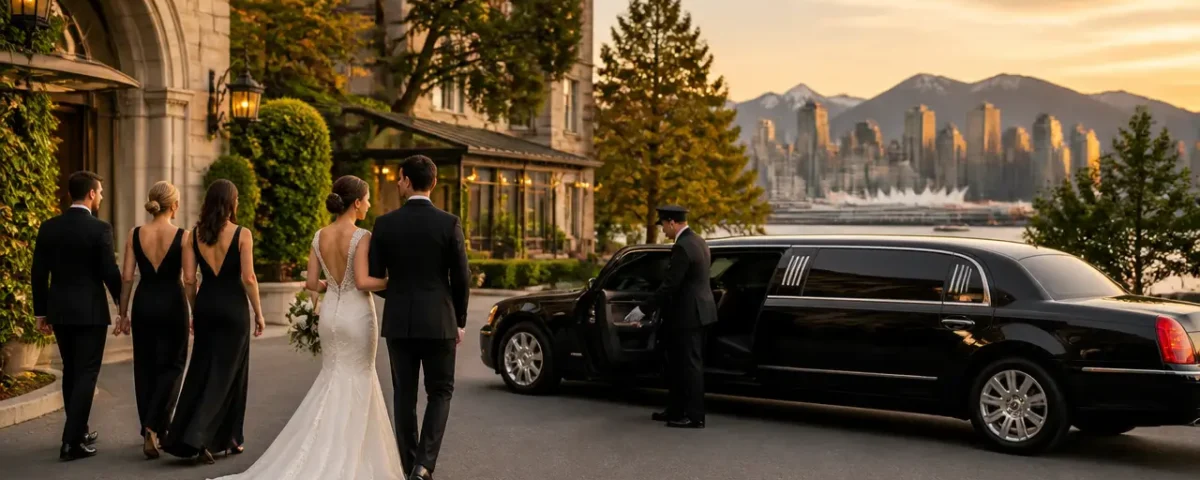
Vancouver wedding transportation timeline planning should begin as soon as your ceremony and reception locations are confirmed. The vehicle itself is only one part of the schedule: you also need to account for loading passengers, parking, photography, venue access, bridge traffic, and the time required to move a group between locations.
A practical transportation plan gives every movement four separate times: when the vehicle arrives, when passengers begin loading, when the vehicle departs, and when everyone must arrive. That distinction prevents a common mistake—booking only the estimated driving time.
When to book a wedding limo in Vancouver
12 to 18 months before the wedding
Confirm the ceremony venue, reception venue, approximate guest count, wedding-party size, and whether guests will need transportation between hotels and venues. This is also the right time to identify special requirements such as wheelchair access, child seats, extra luggage, or an after-party transfer.
Reserve the main wedding vehicle once the date and locations are fixed. Earlier booking is sensible for summer Saturdays, multiple vehicles, large wedding parties, party buses, and routes involving downtown Vancouver, Stanley Park, Richmond, North Vancouver, Whistler, or the Fraser Valley. If your celebration includes guests staying in White Rock or a South Surrey venue, a dedicated White Rock limousine service option may also help simplify that part of the itinerary.
9 to 12 months before the wedding
Book the bridal-party vehicle and any guest shuttle. At this stage, do not rely only on labels such as “SUV limo” or “party bus.” Ask for the provider’s actual passenger capacity, luggage capacity, door configuration, and minimum booking period. A sedan or SUV may suit the couple or VIPs; a stretch limousine can work well for a smaller wedding party; an executive van or Sprinter-style vehicle may be more practical for a medium group; and a coach or shuttle bus is usually easier for moving many guests together.
6 to 9 months before the wedding
Build the photographer’s route before finalizing the transportation schedule. Choose one nearby photo stop where possible rather than scattering several locations across the city. A route from a downtown hotel to the ceremony, followed by one nearby park or waterfront location, is generally easier to protect than a sequence that crosses multiple bridges and neighbourhoods.
Confirm access rules for every proposed location. The City of Vancouver’s park wedding permit information distinguishes between ordinary personal photographs and staged wedding photography. Park wedding ceremonies require permits, and staged photography may have separate requirements. Some locations also restrict the hours when wedding photography can take place. Bloedel Conservatory, for example, requires wedding and staged photography to be arranged outside its regular public hours, while VanDusen Botanical Garden has its own booking, parking, and liaison requirements.
Sample Vancouver wedding-day transportation timeline
The following example is a planning framework, not a guaranteed travel schedule. Adjust it to the exact addresses, ceremony length, photographer’s plan, and time of day.
- 11:30 a.m. — Vehicle arrives: The chauffeur checks the loading area and waits in the agreed staging location.
- 11:40 a.m. — Passenger loading begins: The wedding party gathers, personal items are secured, and the transportation captain checks the passenger list.
- 12:00 p.m. — Planned departure: Leave enough time for the route rather than scheduling departure at the last possible moment.
- 12:30 p.m. — Required ceremony arrival: The group arrives with time to walk from the vehicle, use the restroom, and settle before the ceremony.
- 2:00 p.m. — Ceremony ends: Allow for greetings, family photographs, and a realistic loading period before moving again.
- 2:30 p.m. — Photo stop departure: Include time for the vehicle to stage, the photographer to work, and the entire group to return to the vehicle.
- 4:00 p.m. — Reception arrival: Guests should reach the venue before the entrance, cocktail hour, or scheduled meal service.
For a short urban transfer, adding 15 to 30 minutes beyond the expected drive is a useful starting point. Cross-city routes and bridge-dependent trips need more flexibility. Loading, passenger counting, parking, construction, venue queues, and a late ceremony can each consume time that does not appear in a map estimate.
Planning photo stops without putting the ceremony at risk
Discuss the complete route with both the photographer and transportation provider. The schedule should show where the vehicle waits, whether it can legally stop, how far the group must walk, and what happens if the location is busy or unavailable.
City Hall is a useful example of why this detail matters. Vancouver’s wedding information allows two wedding cars and one officiant car to park free during the ceremony, but the vehicles must move if photographs continue after the 30-minute ceremony. A booking conversation should therefore cover the loading zone and the post-ceremony photo plan, not just the address.
For outdoor parks and gardens, verify permits, opening hours, parking rules, insurance requirements, and any required on-site liaison before promising a couple that a photo stop will fit. Weather can also change the plan. Keep one nearby indoor or covered alternative and decide in advance whether the photographer will shorten the stop, move it, or remove it.
Moving wedding guests between venues
Plan guest transportation around the least mobile or least informed passenger. Give guests one clearly identified pickup point per hotel or neighbourhood where possible, and ask them to arrive 10 to 15 minutes before the stated departure. A transportation captain should hold the manifest, count passengers, and have the chauffeur’s day-of contact information.
For a large group, one shuttle may be simpler than several smaller vehicles. Multiple vehicles can be useful when hotels are spread out, guests have different arrival times, or the reception and after-party require separate movements. Put the pickup address, departure time, vehicle description, and contact number on the invitation details or wedding website. Do not assume that guests will find a loading zone without instructions.
Guests using public transportation should check current information rather than following an old itinerary. TransLink’s Transit app provides trip planning, estimated arrivals, vehicle locations, and service alerts, but public transit is rarely a dependable primary plan for a large wedding party that must arrive together at a fixed time.
Final confirmation checklist
Three to four months before the wedding, send the provider the exact pickup addresses, passenger list, vehicle capacities, venue loading instructions, photo-stop sequence, accessibility needs, and preferred chauffeur contact procedure. Two to four weeks before the date, confirm every time and route again. Ask how the company handles a replacement vehicle if a breakdown occurs.
At 48 to 72 hours, check the forecast, construction, road closures, and event-related traffic. On the wedding morning, review DriveBC delays and closures for routes involving bridges, highways, North Vancouver, the Fraser Valley, or Whistler. Keep a buffer rather than trying to recover lost time by cutting the photo session or guest loading period.
When requesting a wedding transportation quote, provide the date, passenger count, venue addresses, photo locations, pickup times, accessibility requirements, and whether hotel or after-party service is needed. A provider can then build an itinerary around the actual day instead of offering a vehicle for an isolated number of hours. For couples comparing private transportation with taxis, this Vancouver limo and taxi comparison explains the practical differences in coordination and service.
Finally, choose vehicles that match the movement plan, not just the photographs. You can review available styles in the Limo Vancouver image gallery, then confirm capacity and route suitability with the provider. A well-built schedule leaves room for real people to gather, walk, take photographs, and enjoy the day without turning every delay into an emergency.
If the wedding weekend includes a relaxed Fraser Valley outing for visiting family, transportation can also be planned separately from the ceremony schedule; a private limousine winery tour is better treated as a dedicated leisure itinerary than as an extension of the wedding-day shuttle.